Jonathan Heights—Exploration Society
Chasing SunlightJonathan Heights—Exploration Society is one of the book’s most consequential hostile relationships: a conflict between a veteran explorer who insists on pushing beyond the recognized limits of human civilization and an institution that seeks to regulate, suppress, or prevent that movement. The antagonism becomes lethal when the Society’s agent Robert Masterson admits that its warnings were intended to stop Jonathan, and Jonathan responds by killing him rather than allowing another Society operative to interfere.
Origins in Exploration and Control
The relationship begins in a world where the Illuminated King, the Inquisition, and the Reflected Council define humanity through the language of light, civilization, and authorized knowledge. The eastern expedition aboard the airship Endeavor is therefore not merely a private journey. It crosses the boundary between human lands and regions that official power treats as dangerous, savage, or outside legitimate human recognition. Jonathan’s stated purpose is to find sunlight, which most people dismiss as myth, but the expedition also threatens the institutions that control maps, resources, contact with nonhuman peoples, and the limits of acceptable inquiry.
Jonathan’s experience makes him unusually capable of navigating this contested frontier. Before the expedition, he has charted crumbling mines, ruined cities, isolated oases, and caravan migrations, including resources that the Illuminated King does not acknowledge. He understands that an eastward journey requires rest, resupply, repairs, and access to raw terrestrite for zint fuel, not merely courage. This practical knowledge places him in conflict with organizations that may possess authority without possessing his firsthand understanding of the eastern world.
At Danby’s Point, the easternmost terminus of the illuminated human track, the political character of the conflict becomes visible. Human civilization occupies one side of a plateau while strange nonhuman societies occupy the other, divided by a great metal gate under intense zint light. The Inquisition is simultaneously strongest and weakest there: it attempts to contain contact while conceding that trade is unavoidable. Jonathan’s work depends on crossing that boundary. He exchanges human literature for information from Tiuni, receives reports about Thrantin movements and the shifting Verdant Expanse, and uses knowledge gathered beyond human jurisdiction to narrow his routes. The Society’s opposition is thus part of a larger struggle over who may produce reliable knowledge about the world.
The Society’s Opposition
The Exploration Society’s hostility is made explicit when Robert Masterson confronts the expedition after sabotage and attempted escape. Robert states that the Society had warned Jonathan, but that he refused to listen. In Robert’s account, Jonathan has endangered all humanity by sending a dangerous presence back toward Beacon, and the expedition has drawn the attention of beings living in the east. The Society therefore presents its actions as defensive: it claims to be protecting humanity from consequences that Jonathan, driven by his objective, is willing to risk.
Robert’s argument also reveals a hierarchy within the Society. He believes Jonathan’s success makes the journey appear easier than it truly is, insisting that Jonathan was not even a senior member and that the expedition cannot be as difficult as it sounds. Jonathan’s response exposes the difference between witnessing an explorer’s survival and understanding the conditions that made it possible. Returning from the far east on foot is not simply difficult but impossible for someone unable to preserve body and mind amid the alien elements of the region. Jonathan survives because the sunlight within him protects him; Robert attempts to imitate the visible achievement without possessing the same protection.
The confrontation turns the Society’s institutional dispute into personal vengeance. Jonathan says that he believed he had left the Exploration Society behind when he departed Danby’s Point, but now recognizes that he was wrong. He recalls having promised to destroy the next Society agent who crossed his path. The wording makes the killing an act of accumulated grievance rather than an isolated reaction to Robert’s immediate threat. Robert may believe he is acting for humanity, but Jonathan sees him as the latest representative of an organization that has tried to deny his purpose and sabotage his path.
The Killing of Robert Masterson
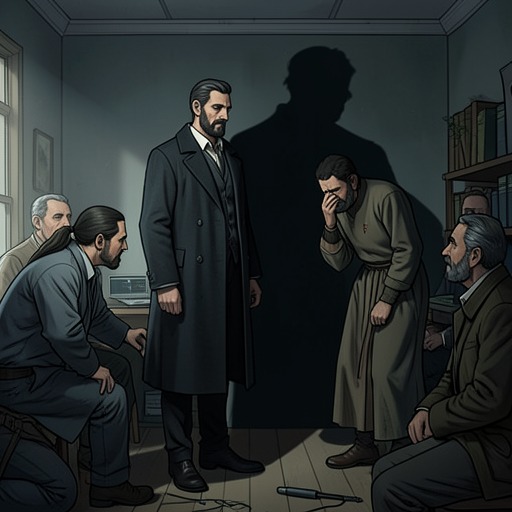
Robert is already trapped against a wall when Jonathan acts. Antomine has identified him as guilty of dereliction of duty, treason, and sabotage, and asks why he would sacrifice himself and his fellow crew. Eleanor has confronted Robert with a dagger, while Antomine’s guards stand nearby. Robert’s fear gives way to conviction as he argues that Jonathan risks the rest of humanity and that the Society’s warning was ignored.
Jonathan does not wait for a legal or institutional resolution. He steps forward, seizes Robert by the throat, and allows the fury he has been suppressing to take control. Robert attempts to break the grip, but cannot. Jonathan’s sunlit soul burns out Robert’s eyes with its intensity; Robert is left scorched and smoking before Jonathan drops the body. The killing confirms that the relationship has crossed from opposition into mortal enmity. Jonathan is no longer merely evading the Society’s restrictions or outmaneuvering its agents. He has made the destruction of its representatives a personal promise.
Antomine reacts with rage and protests Jonathan’s action, but the immediate argument is interrupted when the presence associated with the surrounding danger enters after Robert’s corpse. The interruption is significant: Jonathan’s private violence occurs within a larger crisis that Robert feared, yet the scene does not settle whether Robert’s warning was justified. His death proves the cost of the Society’s opposition, while the continuing danger leaves open the possibility that his fears were not wholly irrational.
Competing Ideas of Risk and Civilization
Jonathan and the Exploration Society differ not only over whether the expedition should continue, but also over who has the authority to judge danger. Jonathan recognizes that the east contains creatures and phenomena that cannot be fought, and his instinct is often to retreat when an ancient ruin releases a force beyond human control. He is not simply blind to risk. His disagreement with the Society concerns the assumption that danger should automatically end inquiry.
The same conflict later appears in Jonathan’s dispute with Antomine over Angkor Leng. Antomine argues that a nest of Umbraught must be purged because the creatures have learned that zint exists and might carry that knowledge westward. Jonathan refuses, saying that the Endeavor is not a navy and lacks the time and resources to survey and cleanse a city as large as Angkor Leng. His response resembles the Society’s position in one respect: both recognize that eastern contact can produce dangers extending toward Beacon. Yet Jonathan rejects the institutional demand to convert every perceived threat into a campaign of containment. He will accept enormous risk for sunlight while refusing to spend the expedition’s limited resources on a mission that does not serve that objective.
Robert’s accusation also exposes the imperial language surrounding the dispute. The eastern peoples and creatures are described through human categories of savagery, darkness, and threat, while the expedition treats their territories as routes to chart, markets to use, and sources of fuel or information. Jonathan’s exchanges at Danby’s Point show genuine expertise and practical engagement with nonhuman societies, but they also place that knowledge within an expansionist project. The Exploration Society’s opposition restrains that project while participating in the same wider system of human boundary-making. The conflict is therefore not a simple opposition between enlightened exploration and ignorant fear; it is a struggle among competing authorities over who may define civilization’s frontier and what humanity is entitled to take from beyond it.
Consequences and Narrative Significance
The Society’s hostility contributes directly to the expedition’s atmosphere of sabotage, pursuit, and distrust. Jonathan’s conviction that the organization remains present even after he leaves Danby’s Point means that the eastern journey cannot be separated from political enemies behind him. Every act of interference confirms his belief that official institutions would rather suppress dangerous knowledge than allow him to test the truth of sunlight.
The consequences extend beyond Robert’s death. The Endeavor’s journey brings back knowledge and artifacts from catastrophes such as the destruction of Tor Ilek, and the return produces enough excitement in Beacon for the period to acquire the names Winter of Blood and Winter of the Shadow. The label is partly mocked and never treated as evidence of anything beyond an unusually eventful season, but it shows how the expedition’s effects enter public life even when institutions minimize them. Curios from Tor Ilek become valuable, and many airmen grow wealthy enough to leave the profession. The world Jonathan and the Society contest is therefore altered materially as well as ideologically.
When Captain Montgomery prepares the Endeavor for another expedition, the departure is treated as less auspicious but not extraordinary. That muted response sharpens the relationship’s irony. Jonathan’s conflict with the Exploration Society has already produced sabotage, a public danger to Beacon, and a killing, yet the machinery of exploration continues. The Society may oppose Jonathan, but exploration itself remains embedded in the life of human civilization. Their antagonism matters because neither side can simply withdraw: Jonathan needs the expeditionary world to reach the east, while the Society and related authorities cannot ignore the knowledge, wealth, and threats that his journeys bring back.